The hidden cost you are not measuring: How planning maturity unlocks profit and AI ready insight

Most contractors carry a hidden cost that rarely appears clearly in reports yet eats into margin on almost every job: time related cost risk created by inconsistent, under mature project planning. Over 40% of project costs are time related, but in many contractor workflows, there is no consistent view of what a day is worth on each project, how often time risk is being created, or how effectively it is being recovered.
Why planning maturity is a profit lever
Growing revenue and profit while maintaining cash flow is challenging in a market of complex projects, tight regulation and competitive tendering. Add in uncertainty around scope, interfaces, supply chains and approvals, and the margin at risk from time overruns becomes significant.
In this environment, the maturity of your planning process is a commercial differentiator, not just an internal discipline. Planning maturity, the combination of process, skills and knowledge, tools and culture, directly influences forecast reliability, recovery of time related costs, and the confidence with which leaders can make decisions about risk, bids and growth.
When maturity is low, symptoms are familiar: planning treated as a passive scheduling function, inconsistent approaches across projects, fragmented data, and a focus on historic progress reporting rather than forward looking scenarios. The result is more unplanned schedule compression, higher spend on avoidable time risk, and weaker commercial positions when change events occur.
AI, context and why process design matters
With AI dominating the news cycle, many contractors are exploring pilots that promise productivity gains, predictive insight or automated reporting. Yet many enterprise AI initiatives fail because they are treated as data or technology projects rather than changes to core business processes.
AI ROI behaves more like a multiplication than an addition: strong data architecture multiplied by weak process maturity still gives a low overall return. If planning and project control processes are fragmented or inconsistent, feeding more data into an AI model simply hardcodes those weaknesses into the future. Context becomes as important as raw data, especially in project planning, where basis of programme, change history and delivery strategy choices determine whether a schedule is reliable for decision making.
Improving planning maturity is therefore one of the most practical ways to prepare for AI. Learning based planning data, structured, contextual and tied to repeatable workflows, gives AI something valuable to learn from, whereas unstructured, outcome only schedule data does not.
From scattered schedules to structured planning intelligence
Many contractors still manage project schedules in manually maintained folders, emails and spreadsheets. Programmes are stored as standalone files, revision histories are incomplete, and crucial context about why a plan was created in a particular way is rarely captured. Months later, those schedules carry little value for learning or AI training, and performance insights are anecdotal rather than data driven.
Moving from this ad hoc state to structured planning intelligence changes the equation. Instead of scattered data, you create structured insight: schedules, baselines, revisions and context stored in a governed way, so teams can see what matters and act faster. Instead of one-off plans, you build reusable knowledge: capturing what works on each project, then reusing proven approaches to reduce rework, improve consistency and speed up delivery.
At portfolio level, this becomes a connected planning ecosystem. Planning data is no longer locked in isolated files or individual laptops but sits in an environment where teams, schedules and systems are linked. Everyone works from one plan, using learning-based planning data that improves with every project and makes questions like “which contracts consistently finish on time and why?” answerable with evidence, not opinion.
How Asta Powerproject with Asta Vision supports higher planning maturity
For many contractors, the journey towards structured planning intelligence starts with the right planning tool. Asta Powerproject is designed specifically for construction and infrastructure, with the flexibility to model complex real-world sequences while remaining usable for planners and delivery teams. Features such as sector specific templates, powerful bar chart manipulation and 4D capabilities help planners represent complex delivery strategies accurately, while visual formats and viewers support team buy in and communication.
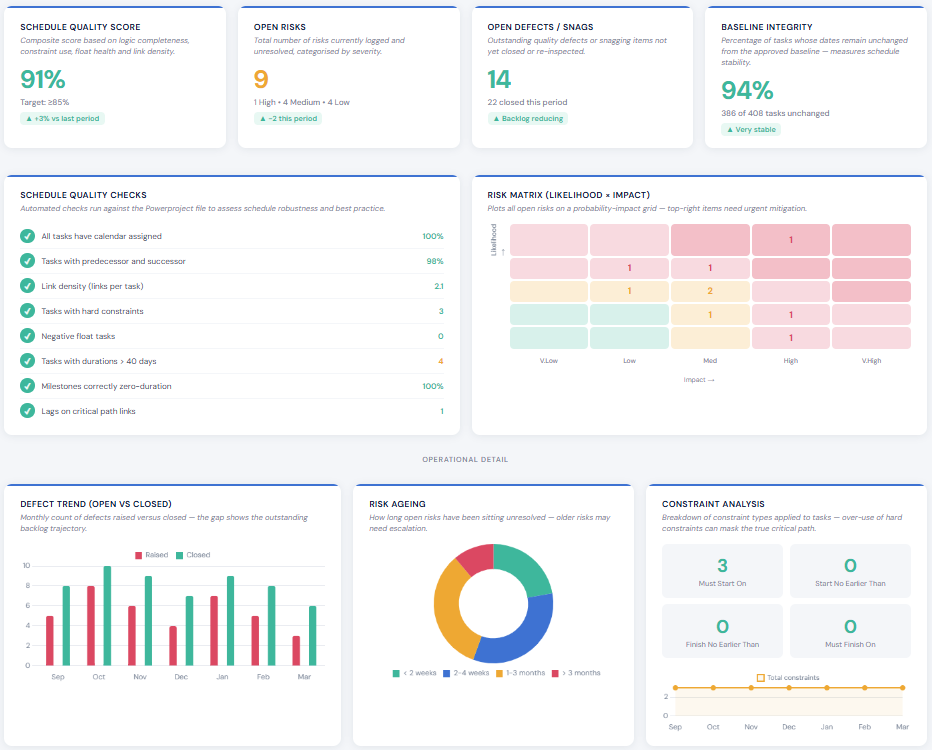
However, even the best schedule loses value if it is managed as a standalone file. This is where Asta Vision adds a web-based layer that turns individual Asta Powerproject schedules into a governed, connected planning ecosystem. Asta Vision provides a central, secure environment for all programmes, revisions and supporting records, with company and contract specific workflows to standardise how planning, change and approvals are handled across projects.
By managing baselines automatically when key workflow steps are taken, and by classifying revisions (for example as progress updates, client changes or scenario plans), Asta Vision keeps context with the schedule rather than letting it disappear into emails or network drives. This creates a living basis of programme that can be interrogated later to understand how delivery strategies evolved and which decisions had the greatest impact on time and cost.
With Asta Vision Plus, this structured schedule data can be exposed securely through APIs to dashboards, data platforms and, increasingly, AI driven tools. Organisations can treat Asta Vision as a governed system of record for plan data, eliminating manual exports and providing a trusted backbone for predictive models and copilots that aim to forecast schedule health, contingency burn and delivery reliability ahead of time.
Asta Powerproject and Asta Vision together don’t just support project delivery, they actively enable maturity growth. They can be introduced at any stage of an organisation’s development, providing a structured foundation that evolves alongside the business.
As companies grow, the platform scales with them, becoming a reliable backbone for continuous improvement rather than something they outgrow. In contrast, many other solutions lack this flexibility, often leading organisations to stagnate or rely on an ever-expanding stack of disconnected tools to fill the gaps.
Planning reliability as a commercial advantage
Once planning is treated as a core business process rather than a compliance activity, the commercial opportunities become clearer. Higher planning maturity, supported by systems such as Asta Powerproject and Asta Vision, can improve profitability in several ways:
- Higher recovery of time related costs on client owned change events, backed by transparent baselines, revision histories and evidence.
- Lower spend on avoidable time risk where delays are contractor owned, because issues are surfaced earlier and more options are available at lower cost.
- More accurate modelling of complex project and stakeholder requirements, improving certainty around time related cost risk and opportunity.
- More competitive pricing with higher confidence in forecasts, supporting stronger tender positions without increasing business risk.
- Higher value planning data that can be reused on future projects and leveraged as an asset when AI capabilities mature.
One of the biggest leaks is unmeasured schedule compression. When projects underperform or when mistakes in the schedule surface late, teams often compress the programme to protect key dates. Without consistent baselines, structured revision history and portfolio level visibility, this compression happens out of sight, increasing cost and risk without generating insight.
By contrast, a higher maturity approach that uses Asta Powerproject to model scenarios and Asta Vision to govern baselines and revisions makes the cost of time risk visible. Leaders can ask better questions: What is the impact of this change on time related costs? How often are we compressing schedules? Which projects consistently maintain their planned dates and why? Those answers become part of the business case for investing in planning processes, skills and tools – and, increasingly, for AI enabled insight that reflects how projects are really delivered.
First steps towards a connected planning ecosystem
Treating project planning as a team sport, not a standalone task, is often the first step towards both higher profitability and AI readiness. The tools and processes chosen for planning affect almost every function, from commercial to operations, yet leaving methods and systems to each client or project can lock in lower maturity and dilute the value of your own data.
Practical early actions include strengthening planning roles with domain delivery experience, so planners help shape delivery strategy rather than merely document it. Selecting planning tools that support collaboration and communication – such as Asta Powerproject’s visual formats combined with web-based environments like Asta Vision – helps secure team buy in and ensure that the plan reflects reality on site. Investigating scheduling systems that can add consistency by design, govern templates and revisions, and capture context data creates a foundation for repeatable workflows and learning across the business.
As AI capabilities develop, contractors that have invested in structured, contextual planning data will be better placed to build reliable models, respond to client scrutiny on time performance, and demonstrate innovation and reliability at tender stage. Those that continue to treat planning as a fragmented, file-based activity will find it harder to generate the same level of insight, no matter how advanced the AI tools they adopt.
Explore how Asta can turn your planning data into measurable profit, stronger commercial positions and an AI ready planning backbone for your business.